Hardware Platform
Cheetah's three automated inspection platforms: Cobot Scanner, Gantry Scanner, and Rack-Mounted Module Scanner.
Cheetah automated inspection systems are built around three hardware platforms, each optimized for a different class of inspection problem.
| Platform | Part Number | Optimized For |
|---|---|---|
| Cobot Scanner | CE-101100 | Complex parts requiring inspection from multiple orientations |
| Gantry Scanner | CE-102000 | Large, relatively flat parts and planar assemblies |
| RMM Scanner | CE-103000 | Connector inspection on large rack-mounted modules and hardware |
The three platforms use different motion and scanning architectures, but share a common operator interface, controls architecture, software platform, and approach to system integration.
Each platform can also be configured by Cheetah for the application. Fixturing, sensors, material handling, controls, and other hardware can be added or modified while retaining the same basic machine architecture and user interfaces.
Cobot Scanner#
CE-101100
The Cobot Scanner is Cheetah's flexible inspection platform for parts that require multiple viewpoints. A collaborative robot moves a 3D laser scanner around the part, combining measurements from different positions into a larger representation.
This allows the system to inspect complex geometry, approach features from multiple orientations, and measure relationships between features that cannot fit within a single scanner field of view.
Typical applications include:
- Complex machined and manufactured parts
- Parts with inspection features on multiple faces
- Assemblies requiring several scanning angles
- Applications where access from multiple orientations is required
The base platform can be configured by Cheetah with application-specific fixturing, additional sensors, automated part handling, and other equipment as required.
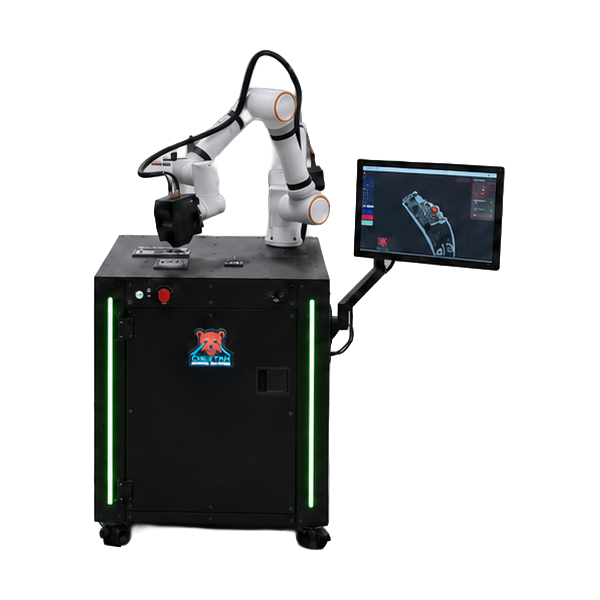
CE-101100 - Cobot Scanner
Gantry Scanner#
CE-102000
The Gantry Scanner shares much of its base architecture with the Cobot Scanner, but replaces the collaborative robot with a two-axis Cartesian gantry and uses a laser profilometer.
The gantry moves the profilometer across the inspection area in controlled linear passes. This architecture is optimized for parts that are relatively large and flat, where most required inspection geometry can be accessed from a consistent direction.
Typical applications include:
- Radiators and heat exchangers
- Printed circuit boards
- Panels and sheet-metal assemblies
- Large, relatively flat manufactured parts
- Applications requiring inspection over a large planar area
Because the motion is constrained to the inspection plane, the Gantry Scanner provides a simpler motion architecture for applications that do not require the range of sensor orientations provided by a cobot.
As with the Cobot Scanner, the base platform can be configured by Cheetah with application-specific fixturing, sensors, part handling, and other inspection hardware.
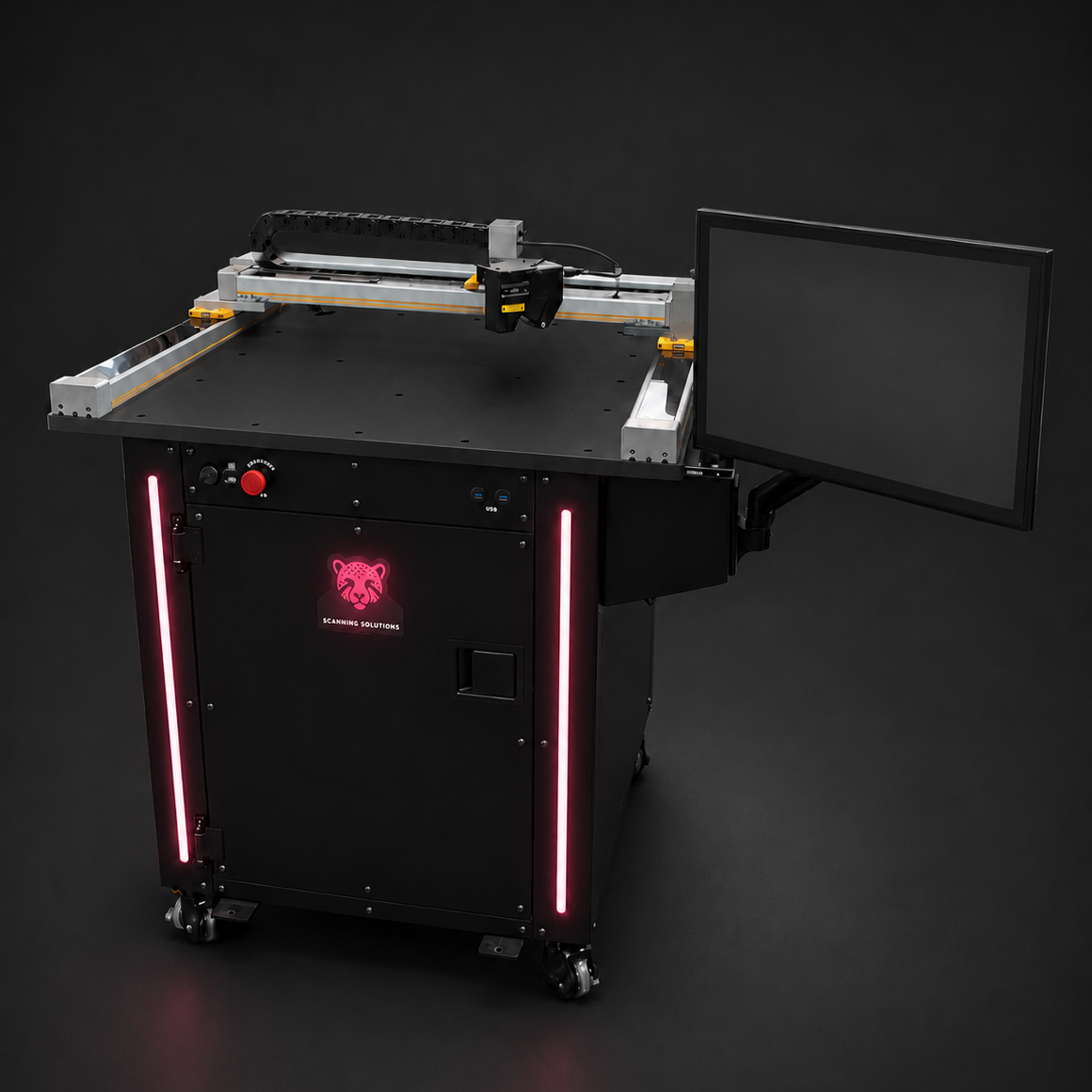
CE-102000 - Gantry Scanner
Rack-Mounted Module Scanner#
CE-103000
The Rack-Mounted Module (RMM) Scanner is a large-format inspection platform designed specifically for server, networking, and other rack-mounted hardware.
Unlike the Cobot and Gantry Scanners, the RMM Scanner is built around the form factor and inspection requirements of large electronic modules. A large Cartesian motion system carries dual laser profilometers and color cameras across the connector end of the product.
The system accommodates hardware ranging from smaller rack-mounted modules up to large-format assemblies as large as:
- 80 cm wide
- 60 cm deep
- 8 cm tall
The combination of 3D profiling and color imaging supports inspection at both the assembly and individual connector level.
At the assembly level, the system can inspect connector position, alignment, height, coplanarity, and other dimensional relationships across the module. At the connector level, the high-resolution sensor data can be used to identify much smaller defects in individual pins, contacts, plastic housings, alignment features, and other connector geometry.
This allows a single inspection to evaluate both how connectors are positioned within the overall assembly and the condition of the small features that determine whether each connector is correctly manufactured and assembled.
Typical inspections can include:
- Connector position, alignment, and coplanarity
- Missing, shifted, or incorrectly seated connectors
- Bent, displaced, or damaged pins and contacts
- Damage or deformation of plastic connector housings
- Damaged alignment, keying, and retention features
- Other dimensional and visual defects in critical connector features
Typical applications include:
- Server and networking modules
- Large-format line cards
- Fabric and switching modules
- Connector-dense electronic assemblies
- Rack-mounted hardware with critical connector interfaces
Large products are loaded across a roller-conveyor surface, allowing heavy or bulky assemblies to be moved into the inspection area without being lifted into place.
The RMM Scanner is designed with production-line integration in mind. Its material-handling architecture can be adapted by Cheetah for powered conveyors and automated loading and unloading when required.
The machine is divided into two primary structures: the product loading and support section, and a large vertical rear structure containing the Cartesian motion and inspection system. This allows the inspection hardware to remain largely independent of how products are presented to the machine.
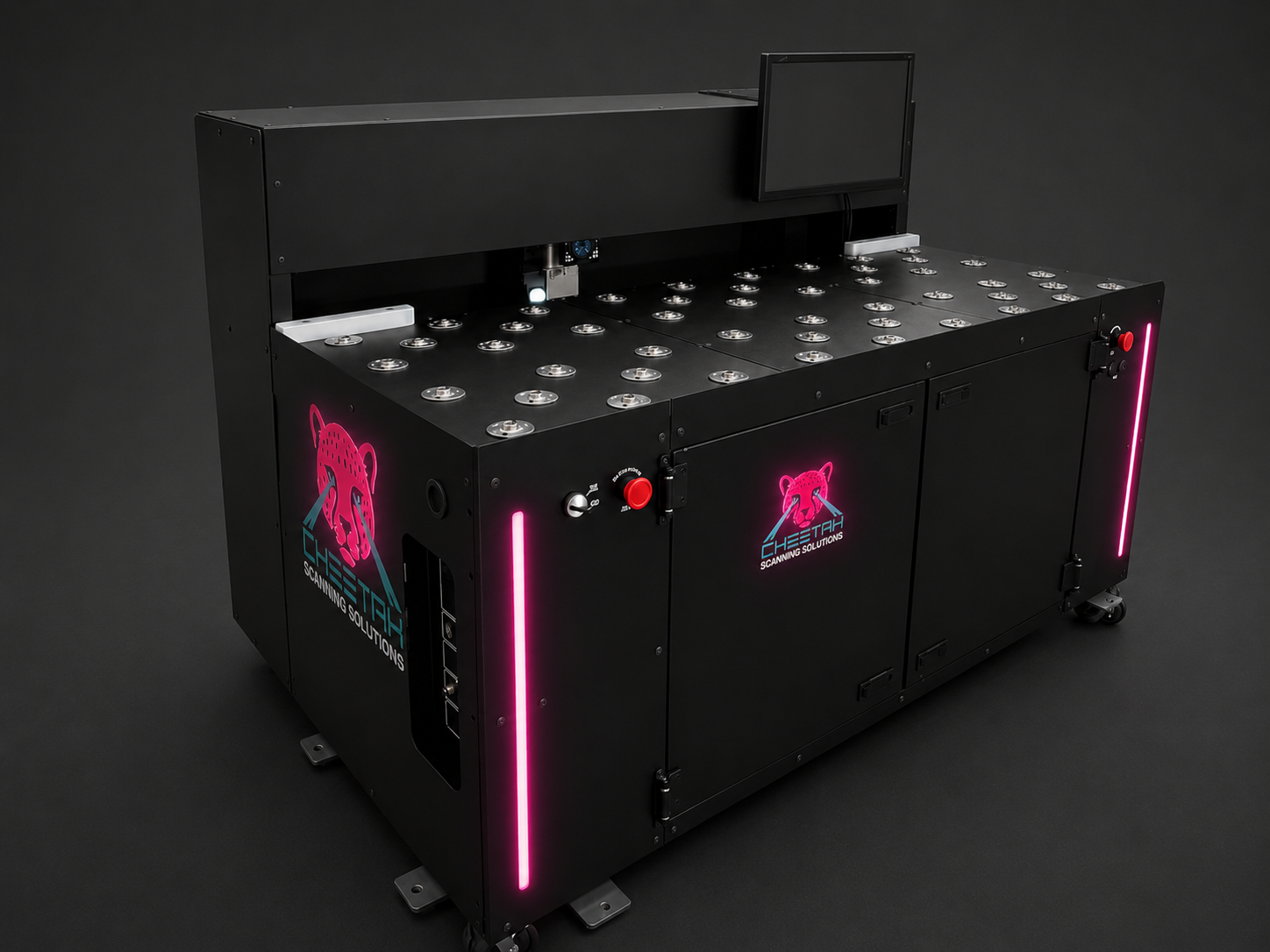
CE-103000 - Rack-Mounted Module Scanner
Common Hardware Architecture#
Although the three platforms use different scanning and motion systems, their operator-facing hardware is intentionally similar.
Operators interact with the same basic touchscreen, machine controls, status indicators, and software regardless of the scanning platform. Customer and factory integration is handled through a common user expansion panel.
This common architecture also gives Cheetah a consistent foundation for application-specific modifications without requiring each machine to become an entirely custom control system.
System Identification and Serial Numbers#
Each Cheetah inspection system has a unique system serial number marked in two locations.
- Chassis marking - the serial number is permanently laser cut into the main machine chassis.
- System identification label - a label inside the electrical control cabinet lists the system serial number together with the system part number. This label is located on the inside of the control-cabinet door.
The location of the chassis marking varies by platform:
- Cobot Scanner and Gantry Scanner - inside the front storage cabinet, on the right-hand side of the chassis.
- RMM Scanner - on the left side of the machine, visible through a cutout in the left-hand cover.
The serial number should be used when identifying a specific system for service, support, configuration records, or replacement parts. Detailed serial-number locations and access instructions are provided in the documentation for each hardware platform.
Touchscreen Interface#
Each system includes an industrial touchscreen running the Cheetah operator interface.
On the Cobot and Gantry Scanners, the display is mounted to an articulated arm. The arm can be installed on either the left or right side of the machine, allowing the interface to be positioned to suit the installation location and surrounding equipment.
The RMM Scanner can use the same articulated mounting arrangement or a fixed display mount depending on the installation.
Operator Panel#
The primary operator controls are grouped together near the upper portion of the machine.
The operator panel includes:
- System power switch - illuminated on/off switch for quick daily startup and managed shutdown, preventing accidental hard power-offs.
- Emergency stop - the primary local emergency stop control. The larger RMM Scanner includes two local emergency stop buttons.
- Two high-speed USB ports - convenient access for temporary peripherals such as a keyboard, mouse, barcode scanner, external storage device, or file transfer.
These controls remain substantially consistent across the product line even when the mechanical architecture of the machine changes.
Machine Status Lighting#
Two RGB light strips on the front of the machine provide visible machine-status indication.
The lighting is software controlled and can be configured for the application. Typical states can include:
- Ready or idle
- Inspection in progress
- Inspection complete
- Operator attention required
- Fault or safety stop
- Pass/fail result indication
Because the indicators are visible from a distance, they provide basic machine status without requiring the operator to remain at the touchscreen.
Integrated Storage#
The Cobot Scanner and Gantry Scanner include a large front-access storage cabinet with an adjustable internal shelf. The RMM Scanner does not include this storage compartment.
The cabinet can be used for equipment associated with the inspection process, including:
- Inspection fixtures
- Sample or reference parts
- Calibration artifacts
- Setup tools
- Cleaning equipment
- Keyboards and other peripherals
- External storage devices
This keeps commonly used equipment with the inspection system without occupying the inspection area.
Customer Integration and System Expansion#
Cheetah systems are designed so that normal customer integration takes place through defined external interfaces rather than through the internal control cabinet.
This keeps the machine controls largely self-contained while still providing access to networking, peripherals, discrete I/O, and external safety systems.
User Expansion Panel#
The user expansion panel is the primary hardware interface for connecting a Cheetah system to customer equipment and surrounding automation.
The panel is built into the side of the workstation and recessed into the machine structure. This protects connectors and protruding cable ends while allowing cables to be routed out through the side of the machine, downward toward the floor, or internally when required.
The user panel provides:
- Three USB ports for permanently or semi-permanently connected accessories and peripherals
- Two device Ethernet ports for additional Ethernet-based sensors, cameras, controllers, or other machine-level hardware
- One 2.5 Gbit/s customer network connection for plant networks, intranets, MES connections, and other higher-level systems
- Safety input for connection to an external emergency stop, interlock, or master safety system
- Safety output providing dual-channel dry-contact indication of the machine's local emergency-stop state
- User I/O with five PNP-compatible inputs and five relay-switched PNP outputs using customer-supplied 24 VDC field power
The panel is located on the right side of the Cobot and Gantry Scanners and on the left side of the RMM Scanner.
More detailed connector information, pin assignments, electrical ratings, and safety-interface requirements are covered in the dedicated user panel and integration documentation.
Control Cabinet#
The main control cabinet contains the industrial computer, networking hardware, safety controls, power distribution, and the robot controller or servo drives required by the platform. Sensor controllers and other application-specific control hardware are installed as required.
The Cobot Scanner and Gantry Scanner use a single-door control cabinet at the rear of the machine.
On the RMM Scanner, the rear motion assembly moves the control cabinet to the front, where a double-width, two-door cabinet takes the place of the storage compartment used on the other platforms.
When the RMM Scanner is integrated directly with a production conveyor and the standard front roller-conveyor assembly is removed, the control cabinet remains with the rear scanning assembly. It can be mounted below the production conveyor or relocated as required by the installation.
The control cabinet is part of the system's factory-integrated control system and is not intended as a general-purpose enclosure for customer modification or third-party equipment integration unless otherwise expressly approved by Cheetah. Customer equipment should normally interface with the system through the touchscreen, operator panel, user expansion panel, and documented software interfaces rather than through internal cabinet wiring.
The cabinet includes the system's main circuit breaker, which may require customer access for service or recovery.
The cabinet also provides room for application-specific hardware integrated by Cheetah or installed as part of an approved system configuration. Depending on the application, this can include additional sensor controllers, communications hardware, I/O equipment, or additional robotic and motion-control hardware.
This allows Cheetah to expand the capabilities of a system while preserving the same external operator and customer interfaces wherever practical.
AC Power#
The base Cheetah inspection platforms are designed to operate from standard 110-120 VAC power.
A 3+ meter power cable with a NEMA 5-15 plug is routed from the user-panel area and can exit through the side of the machine or downward toward floor-level power.
A standard circuit rated for 15 A or greater is sufficient for the base system. Application-specific hardware integrated into a configured machine may change the final electrical requirements.
One Platform, Configured for the Application#
The three product lines use different mechanical architectures because they solve different inspection problems:
- Cobot Scanner - optimized for complex geometry and inspection from many vantage points
- Gantry Scanner - optimized for scanning large, relatively flat parts
- RMM Scanner - optimized for connector inspection on large server, networking, and rack-mounted hardware
Around those different scanning architectures is a common Cheetah platform: operator controls, touchscreen interface, status indication, networking, safety interfaces, expansion I/O, industrial computing, and software.
The base machines are intentionally designed to support application-specific hardware. Cheetah can integrate specialized fixtures, sensors, sensor controllers, part handling, automation interfaces, and other equipment while retaining the standard system architecture wherever practical.
All three platforms also run the same Cheetah software architecture. Inspection programs, operator workflows, results, lifecycle events, and external integrations use a common software interface regardless of which hardware platform performs the inspection.
Hardware Documentation#
Detailed installation, operation, integration, maintenance, and technical documentation is organized by hardware platform.
- Cobot Scanner - CE-101100 - documentation for Cobot Scanner systems
- Gantry Scanner - CE-102000 - documentation for Gantry Scanner systems
- RMM Scanner - CE-103000 - documentation for Rack-Mounted Module Scanner systems
Each platform manual covers receiving and installation, operator controls, system integration, maintenance, service information, and technical specifications for that machine.
Explore the developer platform or talk to us about an inspection application.